Residents - 1912
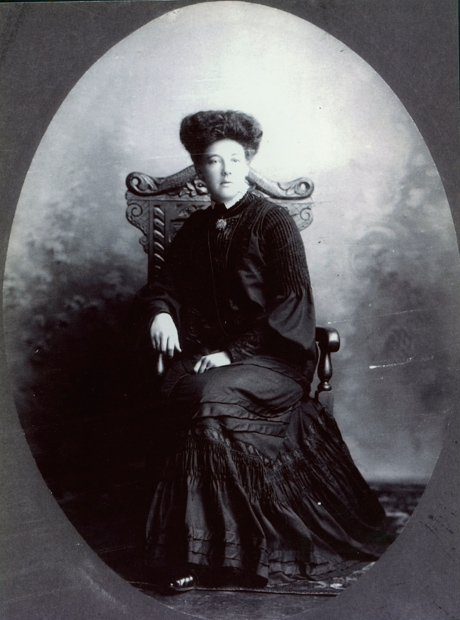
Evelyn Marsden
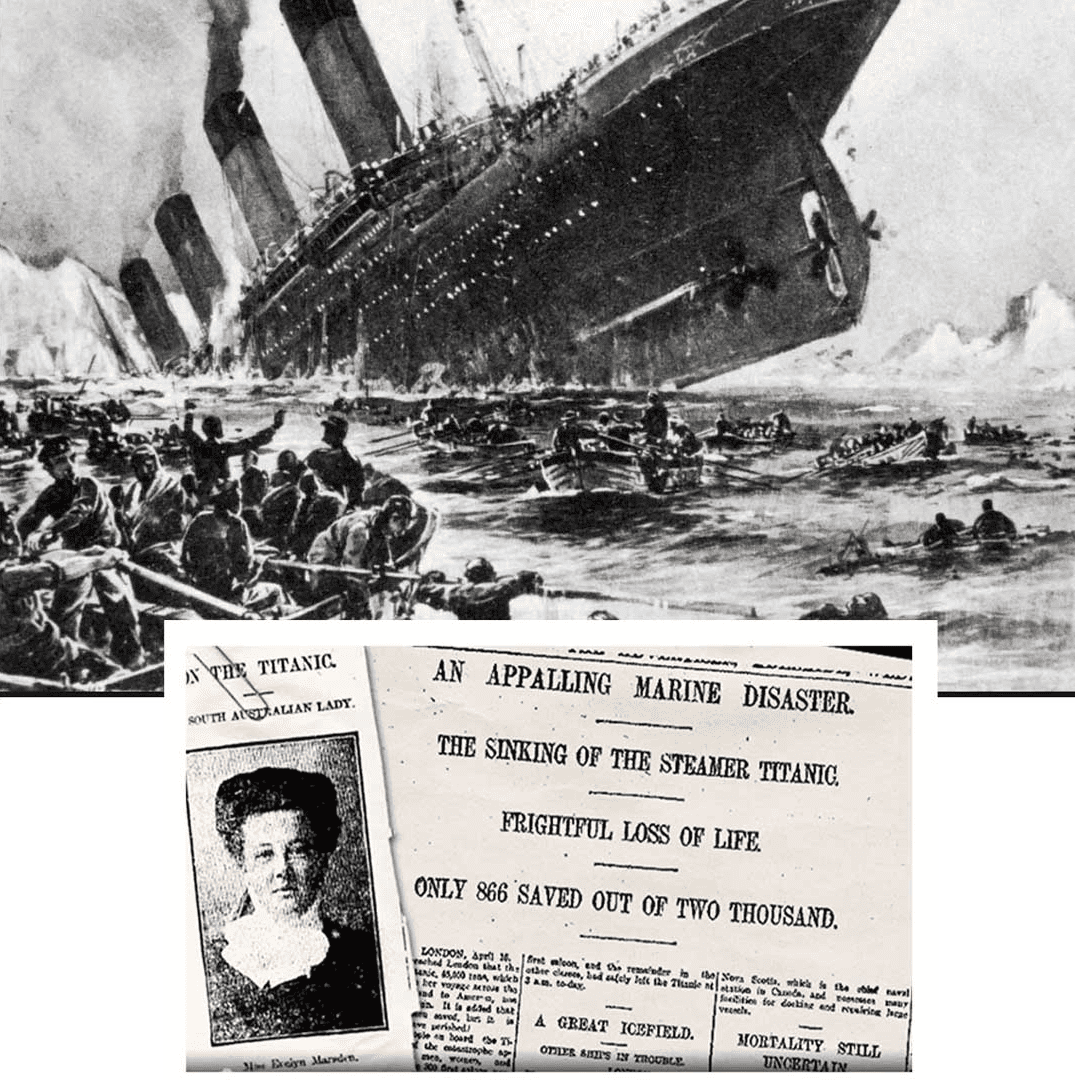
In the dark hours after the Titanic hit the iceberg on the night of April 14, Evelyn and a fellow stewardess were comforted by Assistant Surgeon John Simpson, who had also transferred from the Olympic. He took them to his cabin and gave them whiskey and water, to calm their nerves. They were never to see him again; he was among the tragically high number of those lost.
As passengers and crew abandoned ship, the skill Evelyn had gained on the Murray River was suddenly of vital importance. She helped row lifeboat No. 16 until they were rescued the following morning. It was said that she also tended to a baby. A photo was taken of the surviving stewardesses. Back in Hoyleton Mr and Mrs Marsden spent several days in deep distress waiting for news of their daughter. Finally they received a two word telegram, which told them all they needed to know; ‘Safe. Evelyn’ .
Evelyn Marsden was always a spirited type. Growing up in rural South Australia at Hoyleton she became an accomplished horsewoman. She spent holidays on a farm at Murray Bridge. It was here she was taught to row on the Murray River, even fighting her way against the tide to improve her fitness. Nursing was an ideal profession for such a practical, hands-on person, She trained at the Royal Adelaide Hospital before choosing a life at sea with the famous White Star line.
Evelyn was serving on the passenger ship Olympic when it collided with HMS Hawke on September 20, 1911.
The ship needed major repairs, which is why Evelyn joined the Titanic as nurse/stewardess, looking after the wealthy, First Class Saloon passengers.
Soon after the disaster Evelyn married her fiancée, ship’s doctor William Abel James. James obtained the position of medical officer at the Adelaide Hospital, and they moved into a new apartment in Ruthven Mansions on Pulteney Street, Adelaide. Evelyn went back to the Murray Bridge farm, to thank her old friends for teaching her how to row.
The couple eventually settled in Bondi, where Dr James became a G.P. He enlisted with the A.I.F during WWI and served in Egypt. There were no children from the marriage.
Evelyn died on August 30 1938. Her broken hearted husband passed away just a week later. Both were in their fifties; far too young. They lie together in Sydney’s Waverley cemetery. A headstone was erected in October 2000, after an article about Evelyn was published in a popular women’s magazine.
information source: https://www.encyclopedia-titanica.org/titanic-survivor/evelyn-marsden.html
William Abel James
was born on the 5th October 1880 at Cumbran, Monmouthshire, Wales. The son of a schoolmaster, William John James and his wife Elizabeth Ann, nee Brown. While studying medicine, James served for seven years in 3rd Bn South Wales Borderers, and reached the rank of lieutenant. After graduation in 1906 James obtained a position as a ship’s surgeon with the White Star Line. In the course of his service on the Olympic, he met a 28 year old Australian woman, Evelyn Marsden (1883-1938) who was employed by the Company as a stewardess and nurse. Marsden had been born at Stockyard Creek, Dalkey SA and was the daughter of the stationmaster there. Evelyn Marsden was working on the Titanic on her maiden voyage. After the ship sank, Marsden spent the night in a lifeboat until being picked up by the liner Carpathia next morning. She was the only Australian female survivor. Marsden and James were married on her return to England and left for South Australia, arriving at Semaphore in November 1912. James obtained the position of medical officer at the Adelaide Hospital, and they moved into a new apartment in Ruthven Mansions on Pulteney Street, Adelaide. Later they moved to Wallaroo, South Australia, living and working there for 15 months before finally moving to Newcastle and then Bondi in New South Wales where James set up practice.
James enlisted on the 1st March 1915 at Mitcham and named his wife as his next of kin care of W H Marsden of Yacka, South Australia. He was 34 years old, 5ft 7ins, and weighed 184lbs, and was of fair complexion, fair hair and brown eyes. He was commissioned and sailed from Sydney for the Middle East on the 11th February 1915 with the reinforcements for 1 AGH. He was transferred to 1 AAH on arrival. He served until May 1916, at which time he contracted amoebic dysentery, and was admitted to 3 AGH. He was twice discharged to convalescence, and twice re-admitted. He was sent back to Australia for three months rest in July. He was declared fit for home duty in November, and posted to 7 AGH at Keswick South Australia. He was discharged from the AIF in May 1917, but remained in the AAMC. He was promoted major in March 1918. Notwithstanding all that had happened, James volunteered a second time in June 1918, and was passed fit for overseas service. He reached England in September 1918, and was posted to 2 AAH at Southall. He returned to Australia in May 1919, with his appointment terminated on the 28th August 1919 in the 4th MD. He was issued with the 1914-1915 Star, the British War Medal and the Victory Medal.
James resumed his practice in New South Wales and lived in Bondi. William Abel James and his wife Evelyn both died in September 1938 and were buried in the Waverley Cemetery. They had no children.
Excerpt from Blood Sweat and Fears: Medical Practitioners and Medical Students of South Australian who Served in World War 1. Courtesy of the Authors
Sources:
Likeman R., 2012, From the Tropics to the Desert, Slouch Hat Publications.
http://recordsearch.naa.gov.au/scripts/Imagine.asp?B=7336403
Recorder Port Pirie 24 April 1937 ‘Personal Reminiscences’.
The Sydney Morning Herald 08 and 10 Sep 1938