
Resident - 1912 & Rubeo Cafe Proprietor
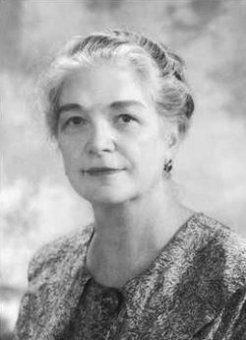
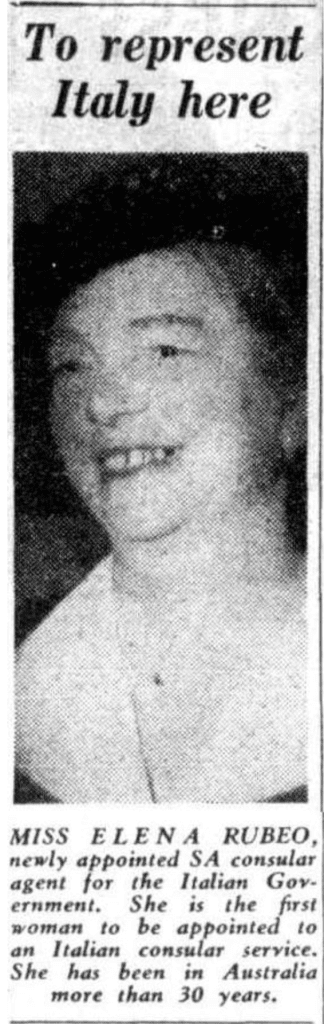
Elena Domenica Luisa Rubeo – the first woman in Australia to be appointed as an Italian Consular Agent and recipient of the Order of Australia.
Born in Rome in 1896, Elena and younger brother Riccardo migrated to Australia with her parents Luigi and Edvige, arriving in Adelaide in October 1908. Once here Elena and her family joined her older brothers Gateano and Alfredo, who had come ahead separately. In Rome Luigi had been a printer and compositor. By 1911 his naturalisation papers show he was working in Angus Street. Elena, meanwhile, attended the Convent of Mercy school in Angas Street
The Rubeo’s were among the first wave of Italians to make South Australia their home. It was a very small community, even by 1921 the census records only 344 people in the state who identified as Italian.
On February 12, 1912 the family, while living on the premises opened the Café Rubeo in the luxurious new apartment building the Ruthven Mansions. Covering two floors, the basement kitchen was entirely tiled for hygiene while ladies and gentlemen’s cloakrooms were provided nearby. The restaurant, covering the space allocated to two shops, measured 80ft (25m) by 30 ft (9m) and was divided in two: one area for the public and another private room for residents. The décor, supplied by Messrs James Marshall and Co, was elegant. The upper walls were fashionably painted pale green above a dark green Walton-Lincrusta dado. Copper fittings and electric lights, as well as leadlight windows in ‘quiet tones’ set the scene. Patrons ate from glassware and crockery imported from Venice, while the silverware came from Hahndorf in Austria.
Gaetano, the oldest of the Rubeo children was the manager while his father Luigi was the proprietor, but it seems that everyone had an opinion on how things should be run. When Paul Hurbert, the chef they engaged sued for unpaid wages, he testified; ‘the place was not being properly run’. He complains that Gaetano, his brothers, sister Elena and mother all seemed to be boss, making it impossible to know who was in charge.
Mr Hurbert was replaced by a chef who had reputedly worked for the King of Italy, and from there on all seems to be smooth sailing. The café served traditional Roman fare for lunch and dinner.
By 1919, but possibly as early as 1915 the cafe had moved to Hindley Street. As all the Rubeo boys enlisted in the Australian Imperial forces in WWI, Elena, like many of the women at the time, stepped into their shoes and helped manage it. She also became highly involved in the Australian (then British) Red Cross. She was later decorated by the Italian organisation for her service. At the end of the war, after the Rubeo boys went their separate ways, the café disappears from the record.
Between 1916 and 1920 Elena rented her own apartment in the building. In the early 1920’s when Elena was in her mid to late twenties, the family left the Ruthven Mansions to live in LeFevre Terrace, North Adelaide. It would remain Elena’s home for the rest of her life.
The Rubeo family seem to have connections in rarified circles. Gaetano originally visited Adelaide as a 13-year-old in the company of Vicenzo De Giorgio, a native of Rome who was returning to South Australia after a stint in Europe. De Giorgio had studied piano and singing in Naples and was renowned locally for promoting Italian Opera. This connection to opera continued through Elena, who acted as interpreter when, in 1924 members of The Grand Opera company arrived in the city.
Elena, too had friends in high places, enjoying the friendship of Princess Borghese and Virginio Borghese, to whom she sent a telegram in 1943.Perhaps this is the link between the family and the Italian chef to the king! In 1928 she returned briefly to Rome, and afterward began importing fine Italian goods, specifically lingerie, for sale to her society friends. Unfortunately, this drew the attention of customs and excise. Nor were her friendships confined to Italians. At a later date Dame Roma Mitchell became godmother to one of Elena’s nieces.
In the early 1930’s both Elena and her father Luigi supported the local fascist branch, established by Guiseppe Amerio, the then Consular Agent for Italy. Elena agreed, as a community service, to teach Italian to the poor children of Italian migrants at Port Adelaide, but this was abandoned after only a year due to lacklustre enrolments. Elena was never a member of the fascio committee or women’s group, and by 1936, the year her father passed away, she had divested herself of all connections with them. However, it was perhaps difficult to fully repudiate them, as in 1938 she was invited aboard the visiting Italian warship the Raimondo Montecuccoli to meet the captain, probably in an effort by the fascio to legitimise their movement with the local Italian community.
By 1940 Elena was keeping a low profile as, being an influential Italian she was being watched by the Australian Security Service. She and her mother took in boarders, while Elena acted as an unofficial advisor to Italian migrants who sought her assistance. Once the war ended, and the influx of migrants increased, she found her services highly sought after. By 1950 she had opened a small business, and for a modest fee would help new arrivals with all the paperwork required.
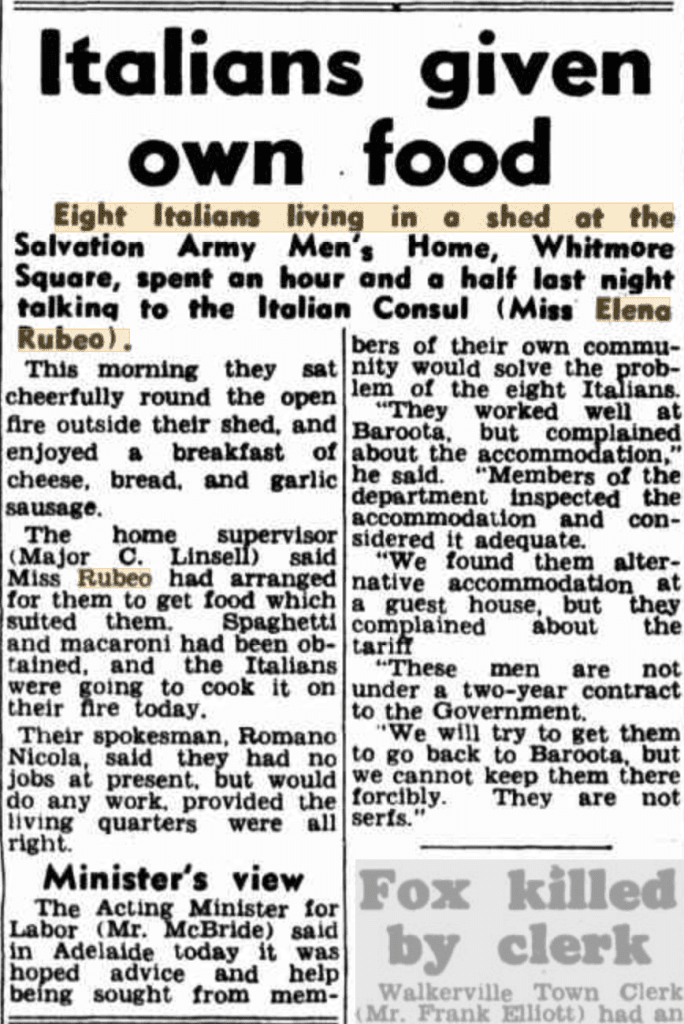
By 1952 the Italian consul of Victoria, Luca Dainelli, was also serving South Australia, Tasmania and Western Australia. He proposed Elena be appointed Acting Consular Agent for this state. She moved her office to 35 Gilbert Place but later worked from her home in North Adelaide. One of her first acts was to arrange a dance in aid of unemployed Italian migrants, which she hoped ‘many Australians would attend’ and also would ‘serve the dual purpose of raising funds and helping migrants and Australians to mix’. In 1953 she was promoted to Honorary Vice Consul, which she held until 1962.
Elena was both dogged and compassionate and was the first official many Italian immigrants encountered in their new home. She was a tireless advocate for her countrymen and women, uncovering the prejudice faced by ‘swarthier’ southern Italians when applying for assisted passage. Despite being European, the Australian government, who at the time was pursuing the ‘white Australia policy’ preferred fairer featured Italians from the north.
Elena was awarded the Order of Australia in 1977 for her services to the welfare of Italian migrants. When she died on the 4th June, 1979 at the age of 82 The Advertiser described her as ‘the introduction to Adelaide’ for the many thousands of post war Italian immigrants, who remembered her with deep love and affection.
https://adb.anu.edu.au/biography/rubeo-elena-domenica-11580
Written and researched by Robyn Heitmann
Elena Domenica Luisa Rubeo - Cafe Rubeo Proprietor & resident 1912